HISTORICAL BUILDINGS
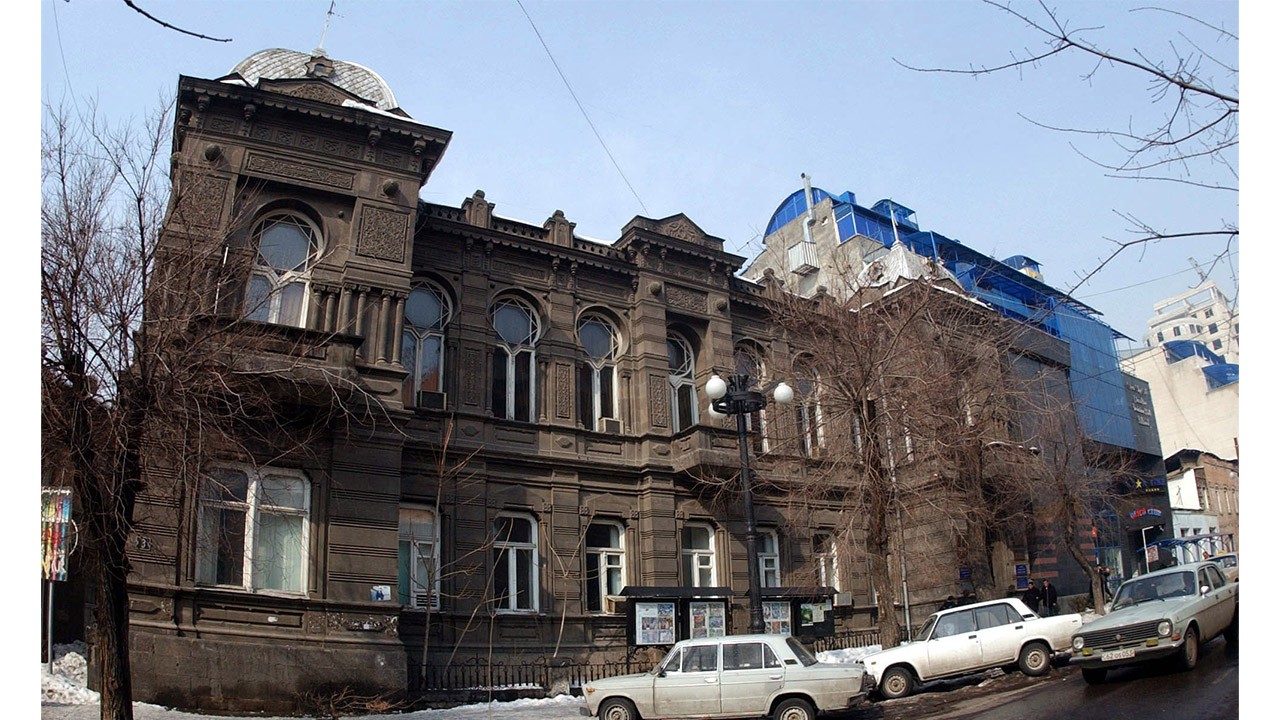
HOVHANNES HOVHANNISYAN’S RESIDENTIAL HOUSE AND CLINIC
1914-1917
Formerly: AOKS BUILDING
The building is located on Abovyan Street, Yerevan.
Physician Hovhannes Hovhannisyan, head of a
permanently operating private surgical clinic in Yerevan, purchased the land
plot in 1915 from Hussein bey Mirzabekov. The two-storey building was
constructed of tuff and covered with a sheet metal roof. The main structure
contained two apartments. From the courtyard side, there was a basement and
nine rooms on each floor. The building was also referred to as a military
hospital.
Until 1923, the first floor of the building
housed Yerevan’s first private surgical hospital with 10 beds. It operated with
two departments: surgical and ophthalmological. The second floor served as the
residence of Dr. Hovhannisyan.
In 1923, the building was nationalized. From 1923
to 1944, it housed Armenia’s first Tropical Institute, also known as the
“Malaria Hospital.” From 1944, the building hosted the Armenian Society for
Cultural Relations with Foreign Countries (AOKS). In the 1960s, it also
accommodated the office of the Ministry of Foreign Affairs of the Armenian SSR.
In the 1950s, an annex was added to the rear of
the building. In 1990, the AOKS building was renovated, and in 2001 it was
privatized. In 2011, the annex was sold, and in 2012 it was demolished; the
“Ibis Yerevan” hotel was built in its place. Since 1996, part of the building
has housed the “Tiflis” café.
The building is two-storey with a basement and
has a complex floor plan determined by its location. The main structure is
slightly recessed (facade length along the street is 26 m, width without
balconies is 18 m). It is intersected by two side wings (risalits).
In the right wing, along the transverse axis of
the building, the entrance hall and staircase are located. On the ground floor,
the hall connects to a longitudinal corridor that links two rows of rooms
(corridor width is 2.8 m; the largest room is 37.6 sq m; ceiling height is 4.2
m).
On the upper floor, the rooms are oriented toward
the southeast (toward the street), with areas of 53 sq m and 38.7 sq m and a
ceiling height of 4.6 m. Three cantilevered balconies also face the southeast.
The second row of rooms is oriented toward the
northwest (inner courtyard). These rooms have rectangular layouts and are
connected to courtyard-side balconies. Adjacent to the main volume, at an
irregular angle along a side passage, auxiliary rooms are located.
The architectural and artistic treatment of doors
and windows is distinctive. The openings combine rectangular and horseshoe
arches. They are accentuated with Ionic columns on the sides, while the lintels
are decorated with keystones and spherical ornaments.
The decorative façade treatment includes
plastered openwork stone ornament panels, a repeating frieze between floors,
and other decorative elements. The structural system consists of load-bearing
tuff masonry with “midis” bonding. The street-facing facades are built of
finely dressed black Yerevan tuff. The ceilings are flat with wooden beams. The
roof is multi-pitched with two domed elements. The balconies are made of stone,
while courtyard balconies are wooden. The entrance hall floor is mosaic.

