HISTORICAL BUILDINGS
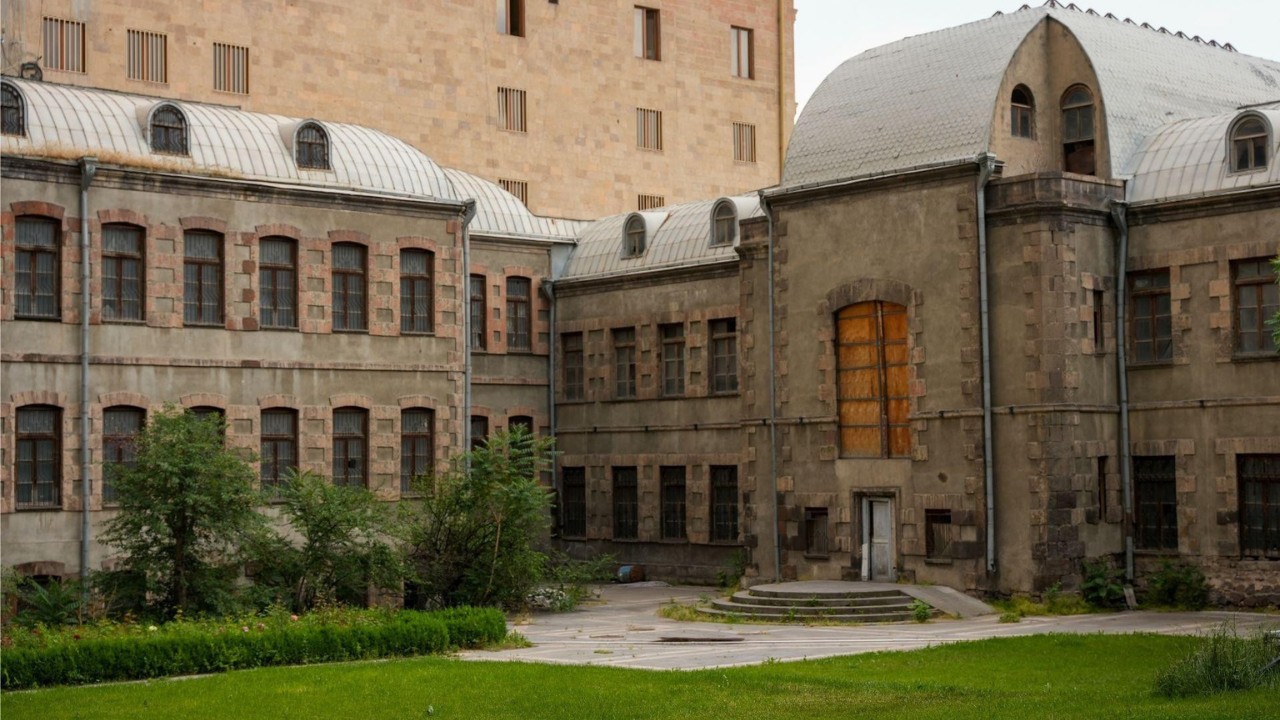
SAINT HRIPSIME GIRLS’ GYMNASIUM
1898, 1905
The building is located on
Amiryan Street.
The gymnasium was founded in
1850 with funds from the Yerevan branch of the Caucasian Women’s Charitable
Society “St. Nina.” It was a state institution operating under official
programs, and instruction was conducted in Russian. Supervision of the school
was entrusted to the Governor of Yerevan (1849–1859), Major General Ivan
Nazarov, with active participation from Vice-Governor Nikifor Blavatsky.
In 1884, by order of the
Trustee of the Caucasian Educational District, the institution was reorganized
into a three-grade girls’ progymnasium, and in 1893 a fourth grade was opened
thanks to the charitable society. In 1898, it was fully reorganized into the
St. Hripsime Girls’ Gymnasium with preparatory, primary, intermediate, and
upper levels, seven main classes and an eighth supplementary class, with two
divisions (Russian language and mathematics). The reorganization was completed
in 1904.
In the 1917–1918 academic year,
the number of students was 526, including 352 Armenians and 119 Russians.
As the institution’s reputation
grew, the building was reconstructed and expanded. In 1859 or 1860, the school
rented two houses with a garden on Nazarovskaya Street (now Amiryan), between
Astafyan (now Abovyan) and Karavanatayan (now Yeznik Koghbatsi) streets, which
were purchased in 1868. That same year, construction of the Church of St.
Gregory the Illuminator began across the street, and part of the land allocated
to the school was returned to the church.
In 1879, a building for
preparatory classes, offices, and a kitchen was constructed. By 1884, the
complex included the main building, five classrooms, dormitories, a dining
hall, the headmistress’s apartment, and a small auxiliary building for staff.
In 1884, a two-story building
was designed (architect Mikhail von der Nonne), which was likely not realized,
but expansion continued in the 1890s. In 1892–1893, a two-story annex with nine
rooms was built in the courtyard (architect Ivan Vagapov).
In 1898, the main building was
constructed on the side of Nazarovskaya Street (with the participation of
Vasily Mirzoyan), housing classrooms, offices, a teachers’ room, a library,
cabinets, the headmistress’s residence, and a dining hall. In 1903–1904, a
second floor was added to a neighboring private house, where dormitories were
arranged, while the first floor was converted into classrooms.
In 1905, the complex was
expanded with a right-side two-story wing with a basement (architect Vasily
Mirzoyan). The basement housed storage rooms, a kitchen, and staff quarters;
the first floor contained two classrooms and a physics laboratory; the second
floor included three rooms for supervisors and one classroom. Staircases were
located at the rear. A separate infirmary building with three rooms and a
bathroom was constructed in the courtyard.
During the First Republic of
Armenia, the building was nationalized and became an Armenian girls’ school.
Instruction was conducted in Armenian, with emphasis on Armenian studies. Part
of the building housed the Ministry of Public Welfare and Labor.
From 1921, it functioned as a
second-level coeducational school. During the Soviet period, various cultural
and educational institutions operated in the building.
By decision of the Yerevan City
Council in 1982, the building was allocated to the Yerevan History Museum,
which had been located in the Blue Mosque complex since the 1930s. Due to
prolonged renovations, the museum moved here only in 1994 and remained until
1997, after which it was relocated to School No. 1 named after Stepan
Shahumyan. In 1995, the building was privatized, and since 1997 it has remained
abandoned.
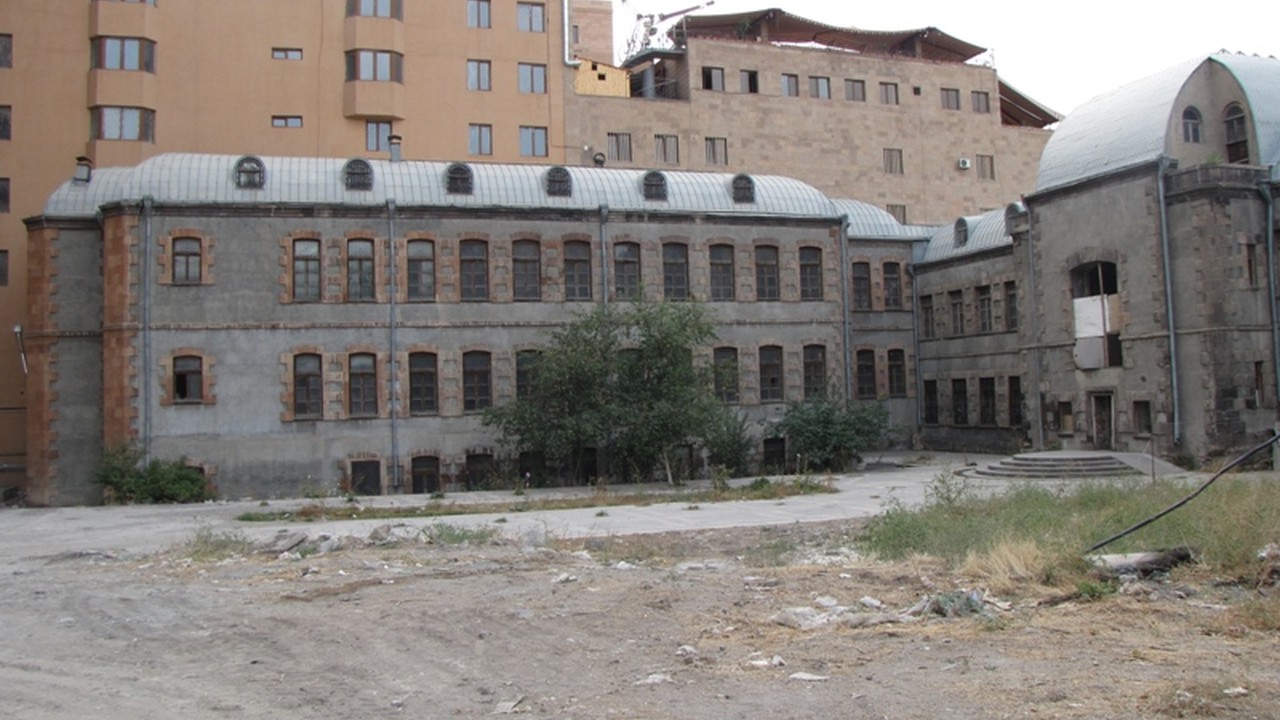
The gymnasium is located along
the red line of Amiryan Street. The rooms are arranged around an internal
courtyard in a semi-enclosed layout. The two-story main building has a
rectangular plan (43.2 × 17.3 m, excluding projections). Classrooms are connected
by a corridor 2.5 m wide.
The central part of the volume
is emphasized. On the first floor is the entrance hall, above which is a hall
surrounded by a mezzanine, with a grand staircase and spiral staircases. The
adjoining right wing has a corridor-type layout.
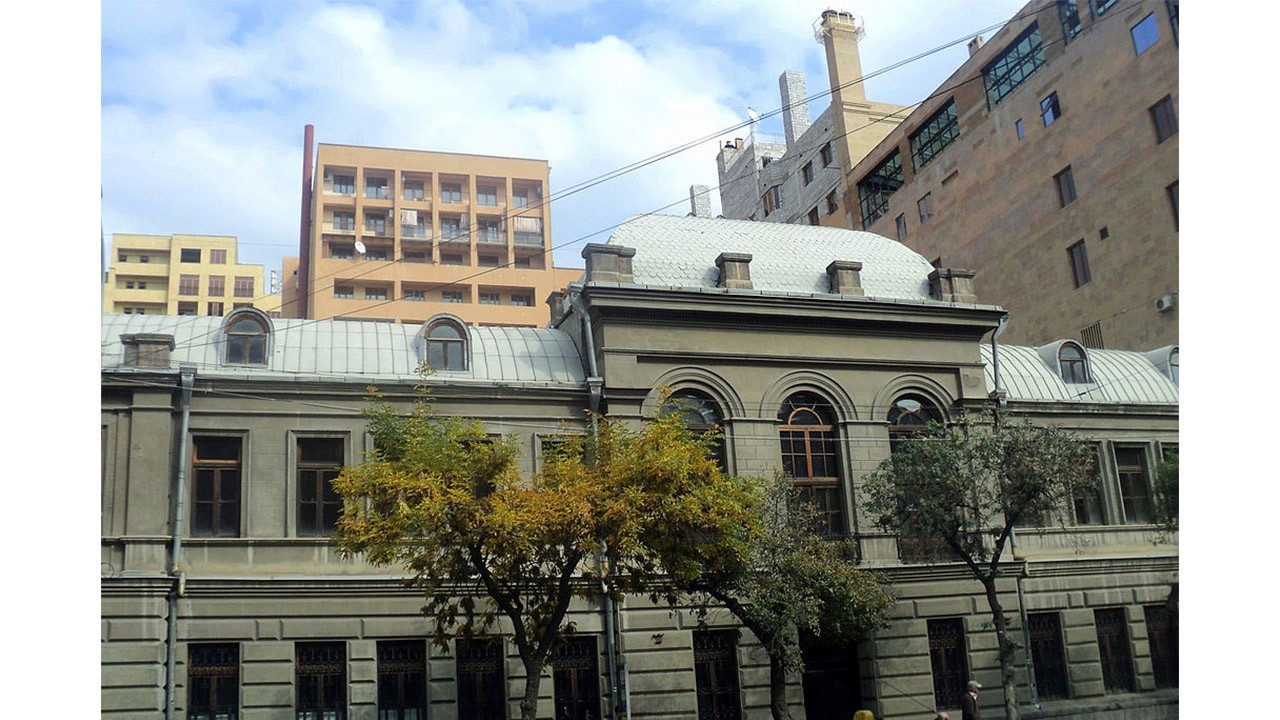
The main southwest façade is
symmetrical, with a dominant central axis marked by the main entrance. The
second floor features three tall arched openings. The remaining windows are
rectangular with frames. The façade is made of roughly hewn stone.
The interior decoration is
distinctive, featuring simple cornices, columns on pedestals, and complex
capitals with floral ornaments and rosettes. The metal railings of the internal
staircases are also notable.
The street-facing façade is
made of brick and covered with cement plaster, while the remaining walls are
stone. Ceilings are flat and wooden, and the roofs are pitched, with a concave
central section.
Alterations have been made
inside the building.