HISTORICAL BUILDINGS
ARAM TER-AVETIKYAN RESIDENTIAL HOUSE AND CLINIC
1912-1914
State Index: 1.6.178.4.1
The
building is located on Abovyan Street.
Initially,
the house belonged to the Dilanyan brothers, Gevorg and Ohan. It was a
single-story structure built of tuff stone. The roof was sheet metal, the floor
was wooden, and the ceiling was plastered with gypsum. It had 6 rooms, 3
anterooms, and 1 kitchen.
In
April 1909, the Dilanyan brothers sold the house to Mathevos Sanagyan, who in
turn resold it in June 1910 to Dr. Aram Ter-Avetikyan, owner of a private
hospital. In 1912–1914, he added a second floor to the house.
During
the First World War, the Red Cross organization operated here.
In
1921, the poet Hovhannes Tumanyan, who had arrived in Yerevan from Tiflis,
lived in this house for one month.
With
a courtyard and five shops, the house belonged to Dr. Ter-Avetikyan until 1923.
In
1923, following the Sovietization of Armenia, the house was nationalized. In
the 1920s, it was inhabited by Soviet Armenian state and party figures Hayk
Yaghubyan, Artashes Karinyan, and Hayk Hovsepyan.
The
house is a structure with an inner courtyard and an almost rectangular floor
plan. The entrance hall and staircase are placed along the central axis. The
main building’s floor plan is dominated by two halls separated by the entrance
hall.
In
the right wing of the floor, rooms are arranged in two rows facing southeast
(street) and northwest (courtyard). The rooms of the left wing are connected by
a corridor. Three cantilever balconies face the street. Along the southwestern
wall, mezzanines were constructed. Some rooms of the courtyard building were
intended for the clinic.
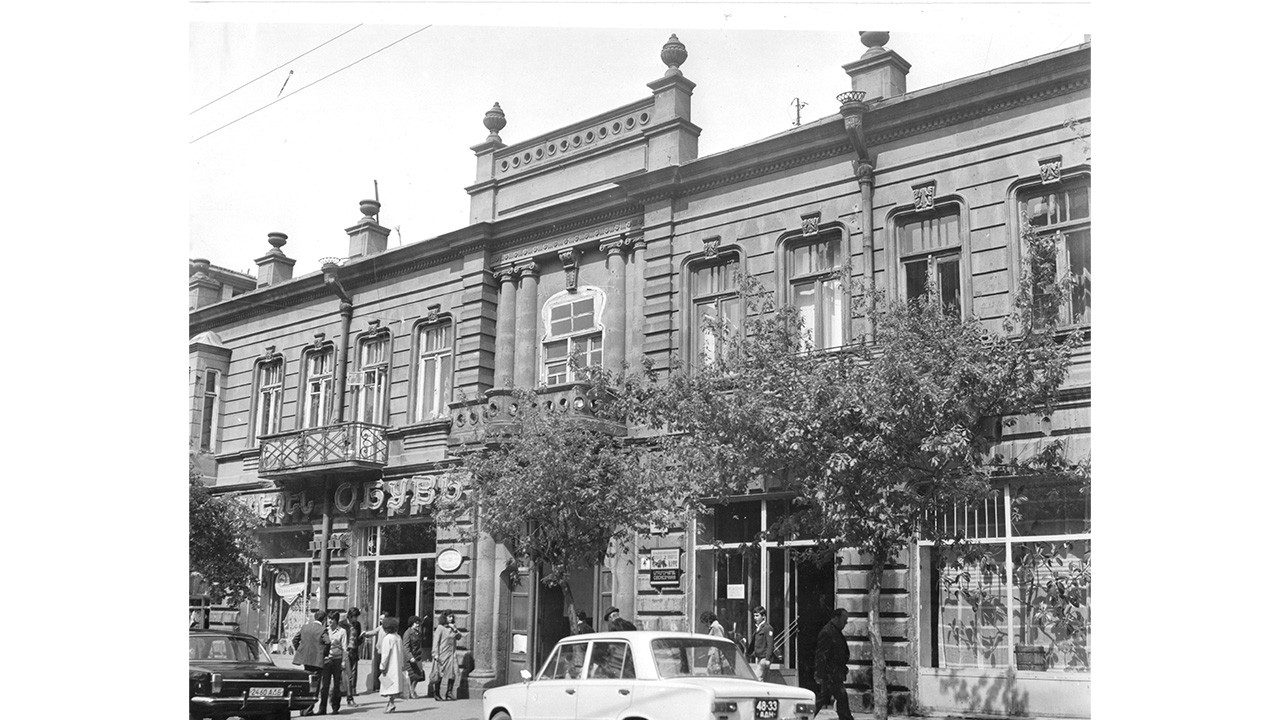
In
the symmetrical composition of the main southeastern façade, the central axis
stands out. The curved entrance opening is framed by half-columns with Ionic
capitals. The upper opening is similar but smaller. A stylized decorative
relief is present on the central frieze of the façade. The wall ends with
circular openings, and the attic is emphasized by decorative vases placed on
pedestals along the roofline. The central balcony railing is decorated with
circular openings, while the other two balconies have light metal
ornamentation. On the ground floor, display windows are framed with rough-hewn
stone. The ceilings are flat with wooden beams, and the roof is pitched and
covered with sheet metal.
The
structural system consists of load-bearing walls built of tuff and brick. The
street-facing façade is clad in finely dressed tuff stone.
The
building is valuable as a monument of late 19th and early 20th-century
architecture. The clinic was one of the two major private medical clinics in
old Yerevan.